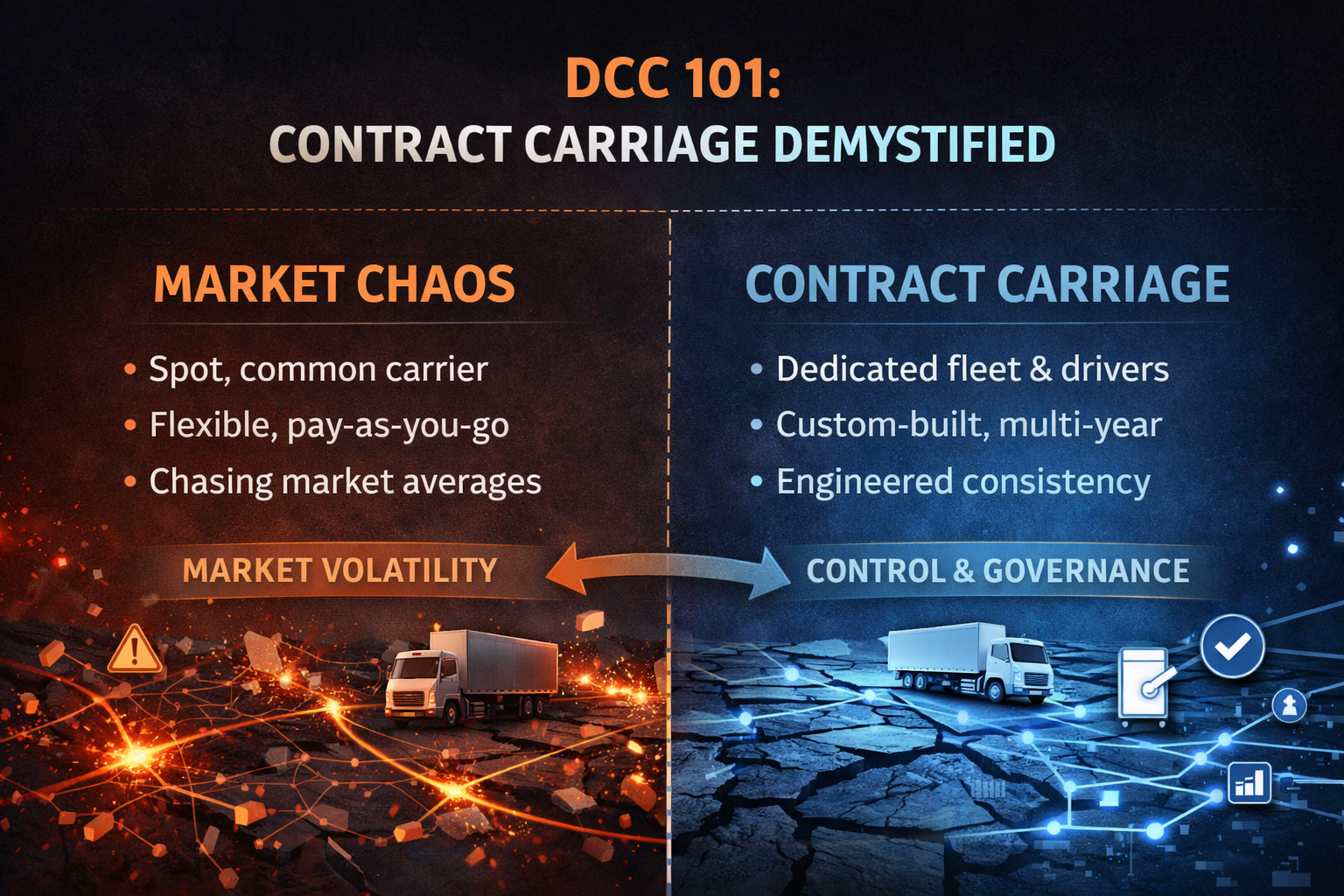
If you are heading into spring bid season and weighing common carriers, a 3PL, or a dedicated partner, the alphabet soup can blur together quickly. Pricing models look different. Risk sits in different places. Service levels can be built to your playbook or left to market averages.
This guide breaks down how contract carriage works so you can compare it cleanly against common and spot options. We will unpack how pricing is built, how risk and insurance are handled, and how to design service levels like OTIF and dwell. You will also find a quick glossary, a buyer’s checklist, and red flags to avoid.
Since 1958, Lily Transportation has engineered dedicated logistics systems for brands that want consistency without running a private fleet. We design one to five year agreements, stand up on-site management, and lead with a safety-first culture that protects people and product. Use this primer to sharpen your RFP and decide when contract carriage is the right tool.
Contract carriage in plain terms
Contract carriage is a transportation agreement where a carrier provides capacity and management tailored to one shipper’s needs under a negotiated contract. The carrier supplies drivers, equipment, and governance that run to your lanes, appointment windows, and KPIs. This differs from common carriers who serve the public at published or market rates and from spot brokerage that flexes daily.
- What is a transport contract? It is the written agreement that sets price structures, liability, insurance, service levels, and remedies between shipper and carrier.
- What is contract trucking? It is the practice of running freight under that negotiated agreement rather than on ad hoc market rates.
- What is an example of a contract carrier? A dedicated provider like Lily Transportation operating a branded fleet and drivers solely for a specific manufacturer or grocery network.
Dedicated transport, often used interchangeably with contract carriage, means assets and drivers are reserved for you. A dedicated shipment is a move that runs on those reserved assets to your schedule and standards.
How pricing is built
Contract pricing blends fixed and variable components so both parties can plan.
- Fixed elements. Fleet availability, driver staffing, management, and domiciled equipment often sit in a fixed monthly or daily capacity fee. This covers readiness, planning, and governance.
- Variable elements. Linehaul and accessorials scale with use. Common variables include miles, stops, equipment type, and seasonality. If volume dips, you may still pay the fixed readiness fee; if it surges, variable components rise with utilization.
- Fuel. Fuel is typically handled via a transparent surcharge indexed to a published benchmark, with a negotiated base rate and peg.
- Accessorials. Accessorials should be clearly listed with definitions and thresholds: detention and dwell, layover, driver assist, redelivery, out-of-route miles, liftgate or reefer standby, after-hours appointments, and chassis or lumper charges where relevant.
Well-engineered contracts define baselines and guardrails. For example, detention may begin after an agreed grace period with tiered rates, and reefer setpoints or pre-cool requirements are specified to prevent disputes.
If you move a mix of FTL and specialized freight, align your contract with your mode profile. For overflow or one-off lanes, asset-backed brokerage coverage can supplement without breaking the model. Learn more about Lily’s freight logistics options for FTL transportation and other modes on our freight brokerage page.
Where risk and insurance sit
Contract carriage is as much about risk transfer as it is about trucks.
- Liability and cargo. The carrier assumes operational liability for drivers and on-road operations and carries auto liability and cargo insurance within agreed limits. Carriers may propose commodity carve-outs or excess limits for high-value or temperature-sensitive freight.
- Indemnity and hold harmless. Mutual indemnities that mirror fault allocation are common. Watch for one-sided language that shifts carrier-caused losses back to you.
- Safety systems. Safety culture is a premium driver of risk outcomes. At Lily, structured training, telematics, and 24/7 exception management reduce incident rates and support claims defense with time-stamped data logs.
- Documentation. The best evidence of a contract of carriage is the written contract itself paired with bills of lading, electronic tender records, and telematics breadcrumbs that verify custody, location, temperature, and time.
Is carriage the same as freight? Not quite. Carriage refers to the act and obligations of transporting goods. Freight is the goods or the charges paid for moving them. Your contract should clarify both the service obligations and the cargo liability terms.
Designing service levels that move the needle
Strong programs are engineered to measurable outcomes.
- OTIF. Define the on-time threshold, measurement window, and exception codes. Align OTIF to customer appointment types and dwell rules.
- Dwell. Set dock-to-door standards, grace periods, and root-cause tracking. Telematics and geofencing make dwell visible and actionable.
- Claims. Specify claim submission windows, documentation, salvage rules, concealed damage handling, and investigative timelines. For temperature-controlled freight, lock in setpoints, pre-cool validation, and continuous data logging.
- Surge and seasonality. Include surge playbooks, asset staging, extended dock hours, and contingency routing so service holds during peak weeks.
Lily designs tailored KPIs, escalation protocols, and surge plans that keep loads on schedule. Our dedicated transportation solutions include on-site leadership, domiciled equipment, and safety-first processes that stabilize appointment performance.
When to choose contract carriage over common or spot
Pick contract carriage when:
- You have steady or seasonal-peak volumes on repeat lanes where dedicated assets will be fully utilized.
- Brand presence and driver training matter at customer docks.
- You need predictable pricing and guaranteed capacity.
- You want risk and compliance owned by the carrier with auditable data.
Consider common carriage or spot when:
- Volumes are irregular, highly fragmented, or opportunistic.
- You are testing new markets or short-lived projects where fixed readiness would be underutilized.
If you operate a private fleet but want to reduce overhead and liability while keeping your brand on the road, a conversion to a dedicated program can be effective. Explore how Lily approaches private fleet conversion in our managed fleet services overview of fleet solutions.
Buyer’s checklist with red flags
Use this shortlist to stress test proposals:
- Pricing clarity. Do fixed and variable elements, fuel formulas, and accessorials have clear definitions and caps? Red flag: vague “market-based adjustments” without mechanisms.
- Service governance. Are KPIs, data sources, and exception codes defined? Red flag: no root-cause process for OTIF or dwell misses.
- Safety and compliance. Are training, ELD, and audit practices documented? Red flag: minimal safety program or poor inspection history.
- Insurance. Are limits adequate for your commodity and lanes, including reefer breakdown or high-value freight? Red flag: broad exclusions or low sublimits.
- Implementation. Is there a timeline with milestone owners and risk mitigation? Red flag: no site survey, no driver transition plan, and unclear change control.
- Flexibility. Are contract terms adjustable one to five years, with language for growth and seasonality? Red flag: rigid term and termination penalties misaligned with your horizon.
Why Lily for contract carriage
Lily Transportation focuses exclusively on dedicated contract carriage with one to five year terms, on-site management embedded at your locations, and a safety culture proven across 60 plus sites in the U.S. and Canada. We combine telematics and data-driven governance with driver training and recognition programs to reduce dwell, improve OTIF, and lower claims. If you need branded equipment, surge playbooks, and a partner that treats logistics as an engineered system, Lily is ready to help.
To see how dedicated transportation fits within broader network design, explore our transportation management solutions for planning and visibility. For cold chain programs, our food logistics practices, including temperature-controlled shipping controls, are built to protect product integrity.
Glossary
- Contract carrier. A carrier that transports goods for specific shippers under negotiated contracts rather than serving the general public at published rates.
- Dedicated transport. Assets and drivers reserved for one shipper’s program; also called dedicated contract carriage.
- Dedicated shipment. A move executed on those reserved assets to the shipper’s schedule and standards.
- OTIF. On-time in-full, a metric that combines delivery punctuality and quantity accuracy.
- Dwell. Time a tractor or trailer spends waiting at origin or destination outside active loading or unloading.
- Accessorials. Extra charges for services beyond linehaul, such as detention, layover, driver assist, or reefer standby.
FAQ
- How do truck drivers get contracts? Drivers and small carriers secure contracts by responding to RFPs, partnering with brokers, or joining a dedicated program where the prime carrier assigns consistent routes under a master agreement.
- What is the best evidence of a contract of carriage? The signed transport contract plus shipment documentation such as bills of lading and electronic records that verify custody and performance.
- Is carriage the same as freight? No. Carriage is the act and obligations of moving goods; freight is the cargo or the charge for moving it.
- What does dedicated transport or a dedicated shipment mean? It means your freight moves on assets reserved for your program, following your schedule and KPIs.
Summary and next step
Contract carriage gives you engineered control over price, risk, and service. Fixed readiness paired with variable linehaul simplifies budgeting. Risk and insurance shift to a carrier with the systems and culture to manage them. KPIs like OTIF and dwell become levers you can actually pull. If you are comparing options for the coming bid cycle, define your utilization, document your service rules, and press partners on safety and governance. To discuss a one to five year dedicated program with on-site leadership and a safety-first approach, connect with Lily Transportation’s dedicated contract carriage team.