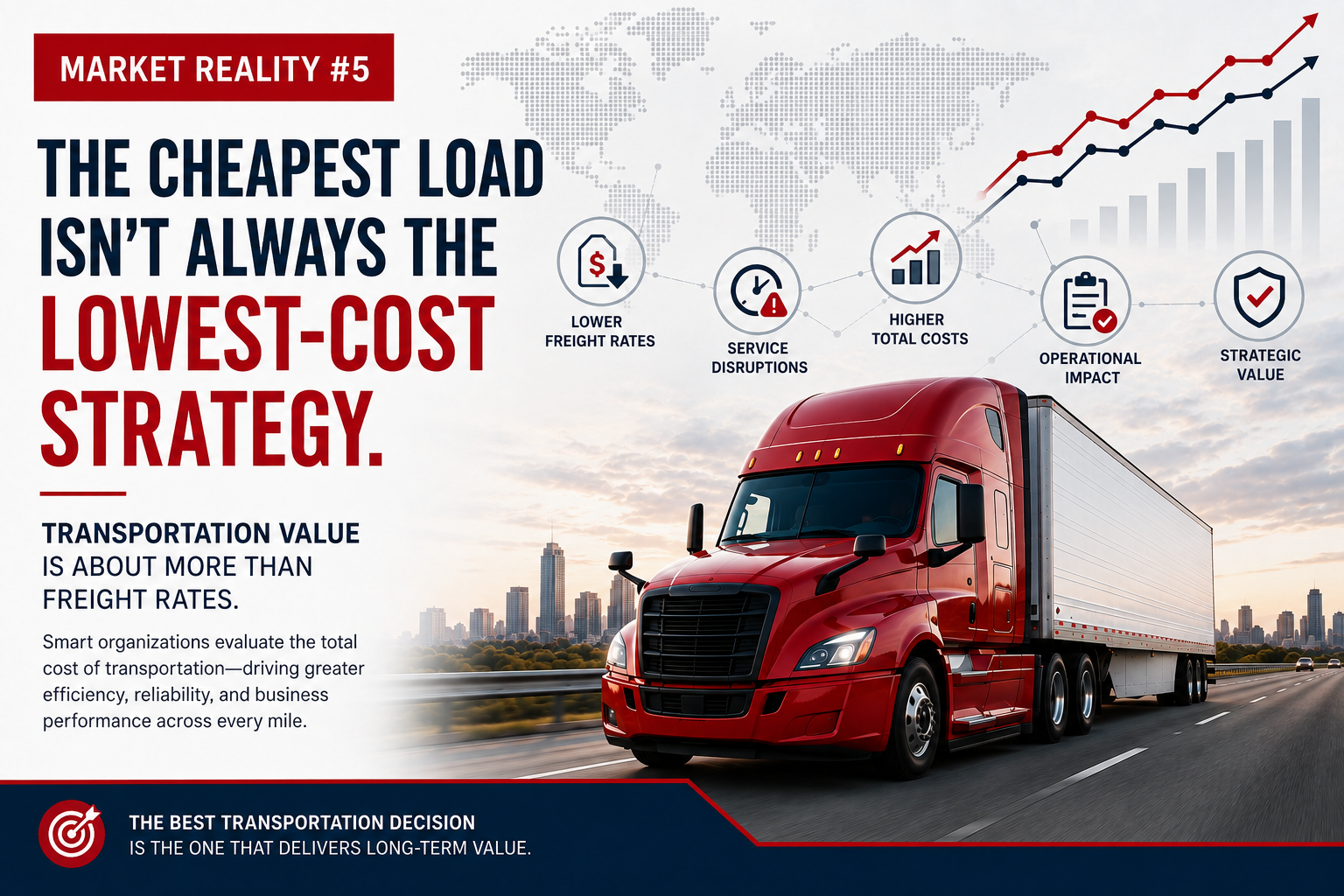
Why Transportation Value Is About More Than Freight Rates
For decades, transportation decisions have often started with a simple question:
“What’s the rate?”
It’s an understandable place to begin. Freight costs are visible, measurable, and easy to compare.
But the lowest rate doesn’t always produce the lowest overall transportation cost.
A shipment that costs less upfront can create additional expenses through service disruptions, inconsistent capacity, delayed deliveries, administrative complexity, or operational inefficiencies.
That’s why many organizations are changing how they evaluate transportation performance.
Instead of focusing solely on the cost of a load, they’re looking at the total cost of moving their business.
The Difference Between Price and Cost
Price is what you pay to move a shipment.
Cost is everything that happens because of that transportation decision.
A lower freight rate may still result in higher overall costs if it leads to:
- Missed delivery windows
- Production interruptions
- Increased inventory requirements
- Customer service issues
- Additional administrative effort
- Higher claims or service recovery costs
- Greater reliance on expedited shipments
None of those expenses typically appear on a freight invoice.
Yet they directly affect profitability.
The organizations achieving the strongest transportation performance recognize that transportation influences far more than freight spend.
Transportation Impacts the Entire Business
Transportation isn’t simply a logistics function.
It affects nearly every part of the organization.
Operations depend on reliable deliveries to keep production moving.
Sales teams depend on consistent service to meet customer expectations.
Procurement relies on dependable transportation to support inventory strategies.
Finance benefits from predictable transportation costs that improve budgeting and forecasting.
When transportation performs consistently, the benefits extend well beyond the shipping department.
Looking at Total Cost of Transportation
Leading organizations increasingly evaluate transportation using a broader set of performance indicators.
Questions have shifted from:
“Who has the lowest rate?”
to
“Who helps us operate more effectively?”
That includes evaluating factors such as:
- Service reliability
- Capacity availability
- On-time performance
- Safety performance
- Driver consistency
- Communication and visibility
- Administrative efficiency
- Cost predictability
Together, these factors create a more complete picture of transportation value.
Why More Companies Are Choosing Strategic Transportation Partnerships
As transportation becomes more integrated with overall business performance, many organizations are rethinking how they source capacity.
Dedicated Contract Carriage is one example of this shift.
Rather than purchasing transportation one load at a time, organizations establish long-term transportation strategies that prioritize operational consistency alongside cost management.
Dedicated transportation can help organizations:
Improve Service Reliability
Dedicated drivers and equipment become familiar with routes, facilities, products, and customer requirements.
Reduce Operational Disruptions
Committed capacity helps reduce dependence on fluctuating market availability during periods of high demand.
Increase Cost Predictability
Stable transportation agreements make budgeting easier and reduce exposure to short-term market swings.
Support Long-Term Performance
Transportation becomes a strategic asset that supports business goals instead of reacting to daily market conditions.
The objective isn’t simply spending less on freight.
It’s creating more value from every transportation decision.
Questions Transportation Leaders Should Be Asking
When evaluating transportation providers, consider asking:
- What costs exist beyond the freight invoice?
- How much does service variability affect our operation?
- What is the cost of missed deliveries or production delays?
- Are we optimizing for the lowest rate—or the best business outcome?
- Does our transportation strategy improve long-term operational performance?
These questions often reveal opportunities that aren’t visible when comparing rates alone.
The Bottom Line
Every organization should manage transportation costs carefully.
Competitive pricing matters.
But transportation decisions shouldn’t be based on price alone.
The most successful organizations understand that transportation creates value through consistency, reliability, visibility, and operational performance—not simply lower rates.
Because the cheapest load isn’t always the lowest-cost strategy.
Sometimes, the best transportation decision is the one that costs slightly more today—but saves significantly more across your business tomorrow.
Are You Measuring Freight Rates—or Transportation Value?
If transportation decisions are based only on the cost of a load, your organization may be overlooking opportunities to improve efficiency, reduce risk, and strengthen long-term performance. Lily helps organizations build transportation strategies that balance cost with consistency, reliability, and measurable business value.
Let’s start a conversation about reducing the total cost of transportation—not just the price of freight.