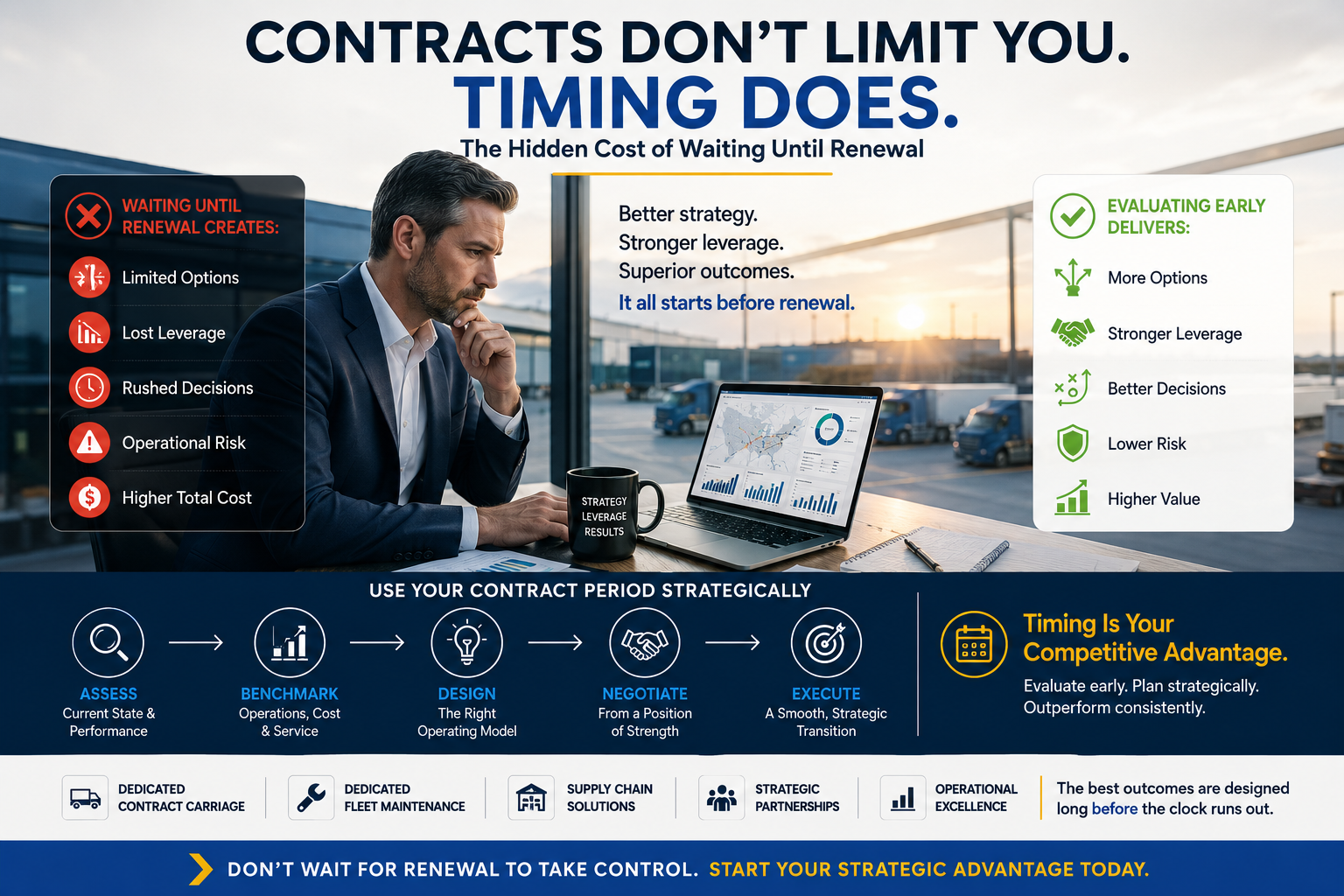
In transportation and logistics, most companies believe the safest move is to wait until a contract renewal period before evaluating new providers, pricing structures, or operating models. On the surface, that approach sounds practical. If a business is already under contract, why create disruption early?
But high-performing organizations are beginning to realize something important:
The biggest risk isn’t being under contract.
The biggest risk is waiting until the contract forces a decision.
This mindset shift is changing how modern companies approach transportation strategy, carrier relationships, fleet optimization, logistics partnerships, and supply chain planning. Instead of viewing contracts as restrictions, leading organizations are using contract periods strategically to evaluate better operating models long before renewal windows begin.
This is the essence of challenger-style transportation strategy.
Rather than reacting to expiration dates, companies are proactively identifying inefficiencies, uncovering hidden operational risks, and designing smarter logistics structures before pressure enters the equation.
The result?
Better leverage. Better planning. Better pricing. Better operational stability.
And most importantly, better long-term outcomes.
This article explores why waiting until transportation contract renewal creates unnecessary risk, how challenger sales principles apply to logistics strategy, and why companies that evaluate transportation partners early consistently outperform those that wait.
The Traditional Transportation Contract Mindset Is Broken
Most organizations follow the same transportation procurement cycle:
Sign a multi-year transportation or logistics contract
Operate within the agreement for several years
Ignore alternative operating models during the contract term
Rush into an RFP near expiration
Compare rates under time pressure
Make reactive decisions before service disruption occurs
This process has become normalized across fleet management, dedicated transportation, supply chain logistics, and third-party logistics (3PL) relationships.
But normalization does not equal optimization.
In reality, this approach creates several hidden business problems:
Reduced negotiation leverage
Compressed implementation timelines
Limited strategic evaluation
Increased operational disruption risk
Surface-level provider comparisons
Reactive pricing decisions
Poor long-term transportation planning
Companies often believe contracts eliminate optionality.
In reality, contracts simply create a timeline.
And how organizations use that timeline determines whether they gain a competitive advantage or lose strategic control.
Challenger Sales Thinking Changes the Entire Conversation
Traditional transportation sales conversations typically sound like this:
“Are you looking to switch providers?”
“When does your contract expire?”
“Can we bid during your next RFP?”
That approach positions the logistics provider as a vendor waiting for permission.
Challenger-style transportation strategy takes a completely different approach.
Instead of asking whether a company is ready to switch, challenger organizations focus on helping leadership teams recognize risks they haven’t fully considered.
The conversation becomes:
Are you using your current contract period strategically?
Are you evaluating your transportation model before pressure exists?
Are you designing future operations proactively or reactively?
Are you benchmarking structure or simply benchmarking rates?
Are you creating leverage before negotiation begins?
This perspective reframes transportation strategy from a purchasing exercise into a business optimization initiative.
That distinction matters.
Because the companies that win in modern logistics are not simply finding lower rates.
They are building stronger operating models.
Why Transportation Contract Timing Matters More Than Most Companies Realize
One of the biggest misconceptions in logistics procurement is that evaluation should happen near contract expiration.
But from a strategic perspective, that is often the worst possible time to evaluate.
Why?
Because pressure changes decision quality.
When transportation leaders, CFOs, procurement teams, and operations executives wait until the final months of a contract, they face several challenges simultaneously:
Service continuity pressure
Pricing pressure
Transition pressure
Internal approval pressure
Operational design pressure
Vendor negotiation pressure
Under those conditions, companies rarely make transformational decisions.
Instead, they default to the safest short-term option.
That usually means:
Extending existing agreements
Focusing only on rate reductions
Avoiding operational redesign
Minimizing change
Prioritizing speed over strategy
This creates a cycle where businesses continually optimize around outdated logistics structures rather than designing better systems.
High-performing transportation organizations understand that evaluation timing directly affects leverage.
The earlier strategic conversations begin, the more flexibility companies maintain.
The Hidden Cost of Waiting Until the RFP
Many procurement teams rely heavily on transportation RFPs to evaluate carriers, dedicated fleet providers, and logistics partners.
While RFPs are useful for pricing comparison, they are often poor tools for operational transformation.
Why?
Because most RFPs are designed to compare vendors against existing assumptions.
They rarely challenge whether the current transportation model itself is the right model.
That distinction is critical.
For example, a transportation RFP may compare:
Carrier pricing
Route rates
Fuel surcharge structures
Equipment costs
Service-level agreements
Driver availability
Delivery KPIs
But it may never address bigger strategic questions like:
Is the current dedicated fleet structure still optimal?
Should routes be redesigned?
Is network density being maximized?
Is asset utilization too low?
Are labor structures creating inefficiency?
Is the company overpaying for operational inflexibility?
Would a hybrid transportation model create better scalability?
When evaluations happen only during the RFP stage, companies often focus on comparing vendors instead of redesigning systems.
That creates what many logistics experts call the “evaluation blind spot.”
Companies think they are conducting a strategic review.
In reality, they are often conducting a compressed pricing exercise.
CFO Perspective: Why Waiting Reduces Financial Leverage
From a CFO perspective, transportation contracts are often viewed primarily through the lens of cost management.
The common mindset sounds like this:
“We’re locked into current rates. We’ll revisit this when the contract expires.”
But challenger-style transportation strategy reframes the issue.
The real financial risk is not the contract itself.
The risk is waiting until leverage disappears.
Transportation contracts directly affect:
Operating margins
Supply chain costs
Labor efficiency
Delivery performance
Inventory flow
Customer satisfaction
Scalability
Forecasting accuracy
When companies delay evaluation until expiration windows, they reduce their ability to:
Forecast future transportation costs accurately
Explore alternative logistics structures
Phase operational transitions gradually
Create competitive pricing leverage
Negotiate from a position of strength
The companies that consistently reduce transportation spend over time are not simply demanding lower rates.
They are proactively evaluating operating models before urgency exists.
That creates optionality.
And optionality creates leverage.
CEO Perspective: Strategic Optionality Creates Competitive Advantage
CEOs rarely view transportation as just a logistics issue.
They view it as a business continuity issue.
Transportation affects:
Customer experience
Operational scalability
Market responsiveness
Revenue growth
Risk management
Organizational agility
Many CEOs believe being under contract means strategic decisions can wait.
But challenger organizations understand something different:
Being under contract does not remove options.
It simply delays visibility into better ones.
That distinction changes how executive leadership approaches logistics strategy.
Instead of waiting for forced decision windows, leading organizations use contract periods to:
Evaluate future-state operating models
Assess scalability risks
Identify structural inefficiencies
Explore technology integration opportunities
Improve transportation visibility
Analyze network optimization opportunities
Benchmark operational resilience
This creates a major competitive advantage.
Companies that prepare early make decisions calmly.
Companies that wait make decisions under pressure.
And pressure almost always reduces strategic quality.
Operations Leaders Understand the Real Risk of Late Transitions
Operations teams are often the most hesitant to evaluate transportation changes during active contracts.
Why?
Because they fear disruption.
Common concerns include:
Delivery instability
Driver turnover
Customer service interruption
Routing disruption
Technology integration problems
Fleet transition complexity
Warehouse coordination issues
Those concerns are valid.
But challenger thinking introduces an important operational reality:
The highest-risk transitions happen when companies wait until contracts are about to expire.
Late-stage transitions create:
Compressed implementation timelines
Limited testing opportunities
Reduced onboarding flexibility
Rushed process design
Increased operational pressure
Poor stakeholder alignment
By contrast, companies that evaluate transportation strategy early gain the ability to:
Design phased transitions
Conduct operational analysis gradually
Test systems before implementation
Align internal teams properly
Reduce disruption risk significantly
In other words, proactive evaluation actually creates safer operational outcomes.
The safest transitions are rarely reactive.
They are designed well before they become necessary.
Transportation Strategy Is About More Than Pricing
One of the biggest problems in logistics procurement is the obsession with rates.
Many companies reduce transportation evaluation to one question:
“Who can do it cheaper?”
But transportation strategy affects far more than immediate pricing.
A well-designed transportation model can improve:
Delivery consistency
Route optimization
Driver retention
Asset utilization
Customer experience
Inventory efficiency
Network scalability
Labor productivity
Risk mitigation
Operational visibility
In many cases, the lowest transportation rate produces the highest long-term operational cost.
Why?
Because poorly designed logistics structures create hidden inefficiencies throughout the supply chain.
This is where challenger-style transportation consulting becomes valuable.
Instead of competing purely on price, challenger organizations help companies rethink the structure itself.
That changes the conversation from:
“How much does transportation cost?”
To:
“How effectively is our transportation model supporting the business?”
That is a far more strategic discussion.
Early Evaluation Creates Stronger Transportation Decisions
The companies making the best logistics decisions today are not waiting for renewal deadlines.
They are evaluating continuously.
That does not mean they are constantly switching providers.
It means they are constantly learning.
High-performing organizations use contract periods to:
Benchmark transportation models
Analyze operational efficiency
Explore alternative structures
Prepare future-state strategies
Evaluate scalability needs
Assess provider performance
Identify technology opportunities
Improve procurement leverage
This approach creates several major advantages:
1. Better Negotiation Power
Companies that begin evaluation early maintain leverage because they are not negotiating under pressure.
2. Improved Operational Planning
Longer timelines allow for thoughtful implementation design and lower disruption risk.
3. Stronger Strategic Alignment
Cross-functional teams can align transportation strategy with broader business goals.
4. More Sophisticated Evaluations
Organizations can evaluate operating models instead of simply comparing rates.
5. Reduced Risk Exposure
Proactive planning reduces the likelihood of rushed decisions and operational instability.
The Future of Transportation Procurement Is Proactive, Not Reactive
The transportation industry is changing rapidly.
Companies face increasing pressure from:
Rising logistics costs
Supply chain volatility
Labor shortages
Customer delivery expectations
Driver availability challenges
Capacity fluctuations
Technology disruption
Economic uncertainty
In this environment, reactive transportation planning becomes increasingly dangerous.
Organizations that continue waiting until contract expiration to evaluate logistics strategy will struggle to maintain competitive advantage.
The companies that outperform their markets will be the ones that:
Evaluate early
Design proactively
Create leverage intentionally
Benchmark continuously
Optimize strategically
Reduce decision pressure
This is the future of transportation leadership.
And it starts with a simple mindset shift:
Being under contract does not mean you are stuck.
It means your timing matters more.
Final Thoughts: Why Challenger Transportation Strategy Wins
The traditional transportation procurement process teaches companies to wait.
Wait for renewal.
Wait for the RFP.
Wait for pricing pressure.
Wait for forced decisions.
But challenger organizations understand that waiting creates weakness.
The strongest transportation strategies are built before urgency exists.
That is how companies:
Improve leverage
Reduce operational risk
Strengthen logistics performance
Optimize transportation costs
Build scalable supply chain models
Create long-term competitive advantage
The most successful organizations are not reacting to contract deadlines.
They are using contract periods strategically to prepare for smarter decisions.
That is the real competitive edge in modern transportation strategy.
And for companies serious about improving logistics performance, the question is no longer:
“When does the contract expire?”
The better question is:
“When was the last time we evaluated our transportation model before the contract forced us to?”
See How Much Risk Your Timing Is Creating
Most companies don’t realize their exposure until renewal forces a decision.
Take a 60-second assessment to see where you stand.