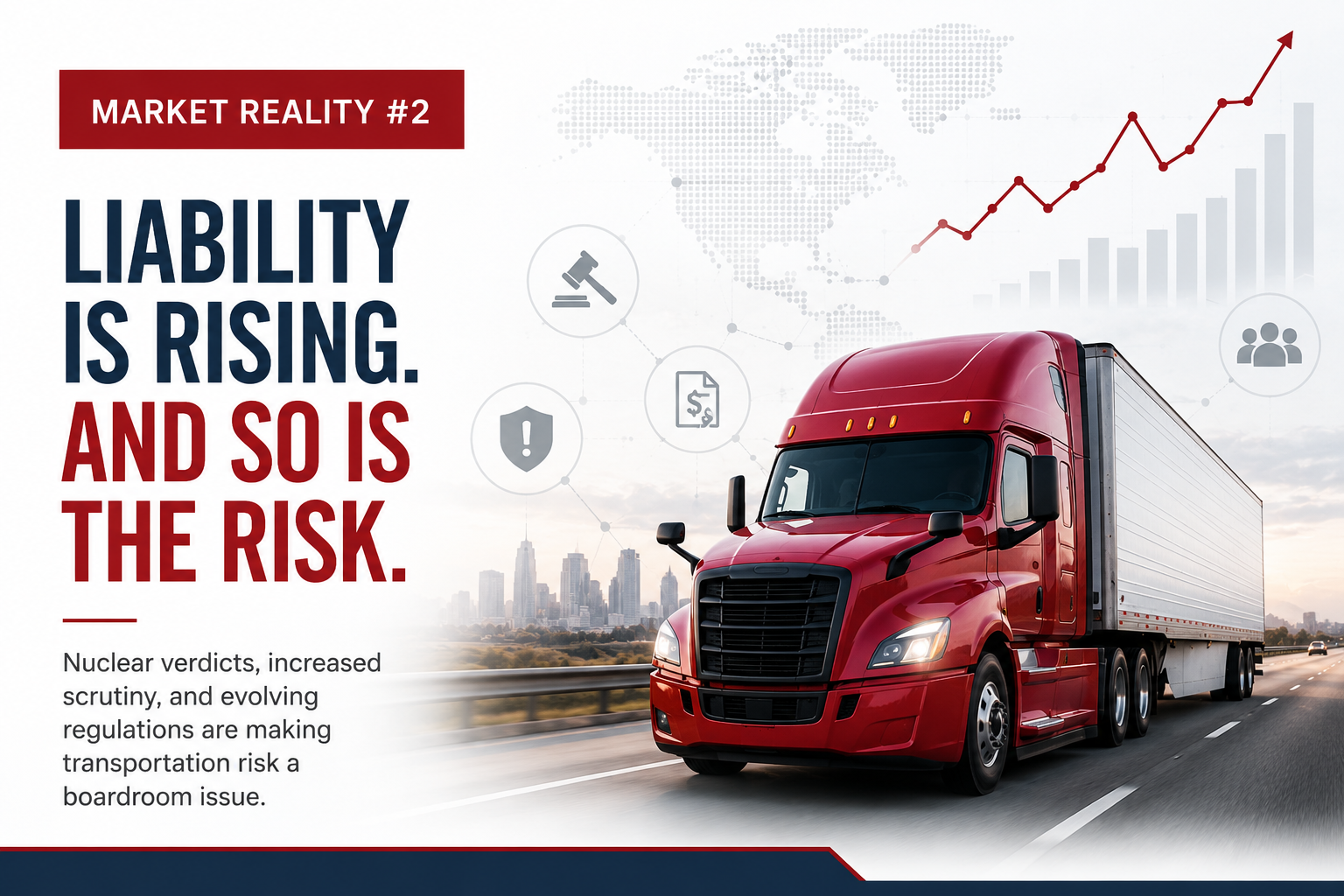
Why Liability Is Becoming a Boardroom Issue for Fleet Executives
Fuel prices.
Equipment costs.
Driver availability.
Insurance premiums.
For years, transportation leaders measured risk using familiar metrics.
Those challenges still matter. But today’s transportation landscape has introduced another risk that can have far greater financial consequences than any of them.
Liability.
Across the transportation industry, litigation is becoming more frequent, verdicts are growing larger, and companies are facing increased scrutiny over every aspect of their transportation operations. What was once viewed primarily as a safety concern has evolved into a business risk that reaches far beyond the fleet.
Today, one serious incident can impact far more than insurance costs. It can affect financial performance, customer confidence, brand reputation, and long-term business continuity.
The conversation is no longer simply about preventing accidents.
It’s about protecting the business.
The Cost of Risk Has Changed
Transportation has always carried risk.
But the financial impact of that risk has changed dramatically.
Over the past decade, so-called “nuclear verdicts”—jury awards that reach into the tens or even hundreds of millions of dollars—have become increasingly common in commercial transportation litigation.
At the same time, plaintiff attorneys have become more sophisticated, using telematics data, maintenance records, driver qualification files, dispatch communications, and operational policies to argue that companies failed to adequately manage risk.
The result is a transportation environment where every operational decision may be examined after an incident occurs.
For fleet operators, the question is no longer:
“Could an accident happen?”
It’s:
“If one does, how prepared are we to defend the way we operate?”
Liability Extends Beyond Insurance
Insurance remains an important layer of protection.
But it cannot eliminate the broader business impact of a serious transportation incident.
Organizations may also face:
- Operational disruption
- Increased insurance premiums
- Legal expenses
- Customer confidence challenges
- Brand reputation damage
- Executive and board-level scrutiny
The true cost often extends well beyond the courtroom.
Why Transportation Strategy Matters
Safety programs have traditionally focused on drivers.
Today’s risk environment demands a broader perspective.
Transportation strategy itself has become part of enterprise risk management.
Questions executives should be asking include:
- Are our drivers consistently trained?
- How confident are we in our maintenance practices?
- Do we have visibility into fleet performance?
- Are our operating procedures standardized?
- Could we demonstrate our safety culture if challenged?
These questions aren’t simply operational.
They’re strategic.
The Value of Operational Consistency
One of the greatest advantages of a dedicated transportation model isn’t simply predictable capacity.
It’s consistent execution.
Dedicated Contract Carriage allows organizations to establish transportation operations built around standardized processes, dedicated drivers, proactive maintenance, and ongoing operational oversight.
That consistency supports more than service performance.
It strengthens accountability.
Organizations operating dedicated fleets often benefit from:
Dedicated Drivers
Drivers become familiar with routes, facilities, customers, and operating procedures.
Consistent Safety Standards
Training expectations, operational policies, and performance management remain aligned across the fleet.
Proactive Fleet Maintenance
Preventive maintenance programs help reduce mechanical failures while supporting regulatory compliance.
Greater Operational Visibility
Technology and fleet management tools provide better insight into vehicle performance, driver behavior, and maintenance activity.
While no transportation model can eliminate risk entirely, consistency helps organizations reduce unnecessary exposure and demonstrate a commitment to safe operations.
Risk Management Has Become a Competitive Advantage
Customers, insurers, and business partners increasingly evaluate transportation providers through a broader lens than cost alone.
They’re asking questions about:
- Safety performance
- Operational controls
- Driver retention
- Fleet maintenance
- Technology
- Risk management
Companies that can confidently answer those questions often position themselves more favorably in today’s transportation market.
Questions Every Transportation Leader Should Be Asking
As liability continues to evolve, transportation executives should evaluate whether their current operating model supports long-term risk management.
Consider asking:
- How well could we defend our transportation practices today?
- Are safety expectations consistent across our operation?
- Do we have visibility into driver and fleet performance?
- Is transportation being managed as an operational expense—or as a strategic business risk?
- Does our transportation strategy strengthen our overall enterprise risk profile?
The Bottom Line
Liability has become one of the fastest-growing business risks facing transportation organizations.
While no company can eliminate every risk on the road, they can reduce exposure through stronger operational consistency, better visibility, and disciplined transportation management.
The organizations that will be best positioned for the future won’t simply have safer fleets.
They’ll have transportation strategies designed to withstand increasing scrutiny, protect their reputation, and support long-term business resilience.
Because in today’s freight environment, the question isn’t whether safety matters.
It’s whether your transportation strategy is doing enough to protect your business.
Is Your Transportation Strategy Helping Reduce Risk?
Transportation is about more than moving freight—it’s about protecting your people, your customers, and your business. If you’re evaluating ways to strengthen safety, improve operational consistency, and reduce exposure to growing transportation liability, Lily can help.
Let’s start a conversation about building a transportation strategy that’s designed for today’s risk environment.