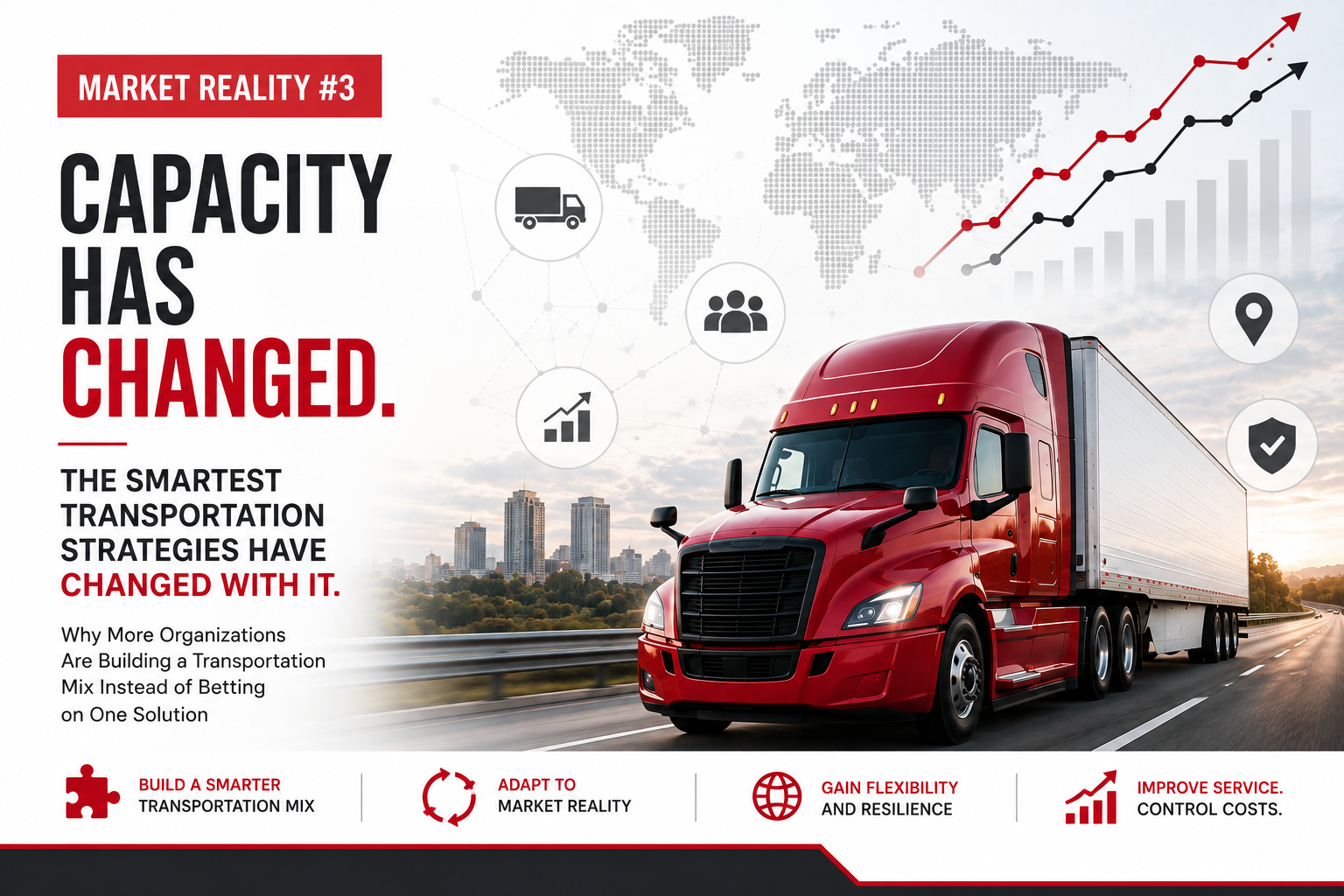
The Smartest Transportation Strategies Have Changed With It.
Why More Organizations Are Building a Transportation Mix Instead of Betting on One Solution
For years, transportation planning followed a familiar pattern.
When capacity tightened, companies turned to the spot market.
When conditions improved, capacity returned, and operations settled back into place.
Many organizations are still waiting for that cycle to repeat.
But today’s transportation market looks different.
Carrier exits, rising operating costs, driver shortages, and increasing customer expectations have reshaped the industry in ways that extend beyond a typical freight cycle.
The challenge isn’t simply finding enough trucks.
It’s building a transportation strategy that can perform regardless of what the market does next.
And increasingly, leading organizations are realizing that doesn’t require replacing everything they already have.
Capacity Is No Longer Just About Availability
For many years, transportation strategy focused on securing capacity when markets tightened.
Today, the conversation has evolved.
Capacity isn’t just about finding trucks.
It’s about ensuring the right capacity is available where your business depends on it most.
That requires more than reacting to market conditions.
It requires designing a transportation network that balances consistency with flexibility.
The Biggest Misconception About Dedicated Transportation
One of the most common assumptions organizations make is that Dedicated Contract Carriage requires replacing their entire private fleet.
For many companies, that’s simply not the case.
The strongest transportation strategies rarely rely on a single transportation model.
Instead, they combine multiple solutions to create a network that’s both resilient and adaptable.
Rather than choosing between a private fleet or outsourcing, many organizations are creating a transportation mix that plays to the strengths of each.
A Smarter Transportation Strategy
Increasingly, organizations are building transportation networks around three complementary components.
Private Fleet
Many companies continue to operate private fleets where they provide the greatest operational or customer value.
Dedicated Contract Carriage
Dedicated transportation becomes the reliable foundation for consistent freight, key customer accounts, or high-volume lanes where dependable capacity and service matter most.
Common Carriers & Spot Market
Third-party carriers and spot capacity provide flexibility for seasonal demand, unexpected surges, and changing business requirements.
Together, these approaches create a transportation network that’s both stable and adaptable.
The goal isn’t replacing one model with another.
It’s building the right combination for your business.
Why This Approach Works
A balanced transportation strategy allows organizations to reduce dependence on any single source of capacity.
It also helps improve:
- Capacity security for critical freight
- Cost predictability for core transportation needs
- Operational consistency across key customer accounts
- Flexibility during seasonal demand or unexpected volume changes
- Supply chain resilience when market conditions shift
Rather than reacting every time the market changes, organizations create a transportation foundation that remains dependable while preserving the flexibility to adapt.
Transportation Doesn’t Have to Be All or Nothing
The transportation industry often presents organizations with two choices:
Keep everything in-house.
Or outsource everything.
In reality, many of today’s highest-performing supply chains do neither.
Instead, they build transportation strategies that combine private fleets, dedicated transportation, and market capacity in ways that support their unique operations.
Transportation becomes less about choosing one model.
And more about choosing the right role for each.
Questions Transportation Leaders Should Be Asking
As capacity continues to evolve, consider asking:
- Which customer accounts require guaranteed service levels?
- Which lanes would benefit from committed capacity?
- Where does our private fleet create the greatest value?
- How much of our operation depends on unpredictable market availability?
- Are we relying on one transportation model when a blended strategy would perform better?
The answers often reveal opportunities to strengthen both service and operational resilience.
The Bottom Line
The freight market will continue to change.
Capacity will tighten.
Demand will fluctuate.
Unexpected challenges will arise.
The organizations best positioned for the future won’t necessarily have the largest fleets or the lowest freight rates. They’ll have transportation strategies designed to perform through changing market conditions.
For many, that doesn’t mean replacing an existing private fleet. It means strengthening it.
By combining the consistency of Dedicated Contract Carriage with the flexibility of private fleets and common carriers, organizations can create transportation networks that are more resilient, more predictable, and better aligned with their business goals.
Because the smartest transportation strategy isn’t about choosing one solution.
It’s about building the right mix.
Build a Transportation Strategy That Fits Your Business
You don’t have to choose between operating a private fleet and outsourcing your transportation. Transervice helps organizations design transportation strategies that combine dedicated capacity, private fleet operations, and flexible carrier solutions to improve service, reduce risk, and support long-term growth.
Let’s discuss how the right transportation mix can strengthen your operation.